
Energy
CatChek: Boosting Eagle Ford Production
Background
The Eagle Ford Shale in South Texas stands as a cornerstone of North American energy production. However, its complex geology and challenging operational conditions demand innovative solutions to maximize hydrocarbon recovery. This case study examines the successful application of CatChek®, a cutting-edge shale inhibitor technology, in addressing key challenges faced by operators in the Eagle Ford Basin.
The Eagle Ford Basin is a prolific shale play known for its complex geological formations and challenging drilling conditions. Operators in the region face significant hurdles in optimizing well placement and maximizing hydrocarbon recovery.
Accurate wellbore positioning is crucial to avoid costly drilling hazards, ensure effective reservoir stimulation, and ultimately, improve production performance. Traditional geological evaluation techniques often fall short in providing the precision and real-time data necessary to navigate these complexities.
Additionally, issues related to clay swelling and fines migration can significantly impact well productivity, requiring specialized chemical solutions to mitigate these risks, enhance well performance, and ensure long-term operational success.
Key Challenges
- Complex Geology: The Eagle Ford formation’s heterogeneity, including variations in lithology, porosity, permeability, and fractures, complicates the prediction of reservoir sweet spots and well trajectory optimization.
- Drilling Hazards: Subsurface uncertainties increase the risk of encountering faults, high-pressure zones, and unstable formations, leading to costly downtime and wellbore damage.
- Reservoir Stimulation: Precise well placement is critical for effective hydraulic fracturing. Poor placement leads to inefficient stimulation and reduced production.
- Production Optimization: Understanding reservoir properties and fluid flow is essential for maximizing recovery. Accurate well placement ensures efficient drainage and prevents premature well decline.
- Clay Swelling & Fines Migration: Water-sensitive clays can swell, causing wellbore instability and reduced permeability. Fines migration can clog pore throats and restrict fluid flow, highlighting the need for specialized chemical solutions.
Case Study Data
The data presented reflects the application of CatChek® compared to alternative chemistry across 1,735 wells over a two-year period (2021-2023). Information was sourced from Frac Focus with Frac Knowledge and verified with Enverus, leading industry databases.
The production data covers four counties in Texas: Dewitt, Karnes, La Salle, and McMullen. Production was measured at 3, 6, 9, and 12 months, comparing wells treated with CatChek® to offset wells using alternative chemistries.
Several factors were considered simultaneously, including an average frac fluid volume of 200,000 bbl/well and a proppant amount of 18.7 MM lb/1,000 ft lateral length. The production data was normalized based on lateral length, lateral length plus frac fluid volume, lateral length plus proppant amount, and all three factors combined (lateral length plus frac fluid volume plus proppant amount). It’s important to note that data from refracs was not included in the analysis.
Outcome
By implementing CatChek®, operators in the Eagle Ford achieved significant improvement in well productivity and overall recovery.
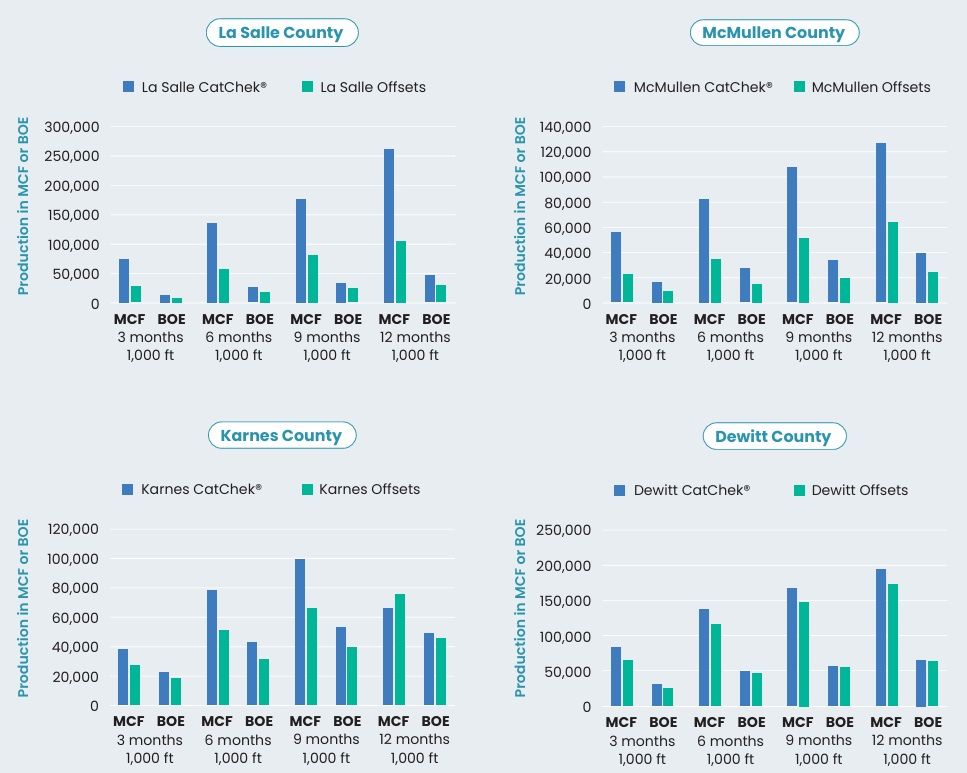
CatChek® optimizes reservoir performance to maximize hydrocarbon recovery by reducing water cut and increasing flow rates. Wells treated with CatChek® showed a 51% higher BOE production rate at three months and an average of 42% higher BOE production over a one-year period compared to offset wells without CatChek®.
Wells treated with CatChek® also demonstrated continued improvement in production over time. Specific production data points are visible in the image for each county, showing increased production over time.
The successful application of CatChek® in the Eagle Ford Basin demonstrates its effectiveness in addressing complex geological challenges and optimizing hydrocarbon recovery. CatChek® significantly enhances well productivity, reduces operational risks, and improves overall economic performance of the well.
Outcomes
Results
51% Higher BOE production
CatChek®-treated wells show 51% higher BOE production at three months and 42% more over a year than untreated wells.
Continued Improvement
CatChek® continually improves production over time.
1,735 wells in the study
Data presented reflects the application of CatChek® compared to alternative chemistry across 1,735 wells over a two-year period (2021-2023). Information was sourced from Frac Focus with Frac Knowledge and verified with Enverus, leading industry databases.
Related solutions
Solutions used on this project
Talk to our team
Tell us about your site and we'll route your enquiry to the right engineer.