
Infrastructure
Woolworths Moorebank PFAS Treatment
The Woolworths Moorebank Regional Distribution Centre (MoRDC) project includes the design and construction of a new 71,790m2 automated warehouse facility scheduled to open in 2024.
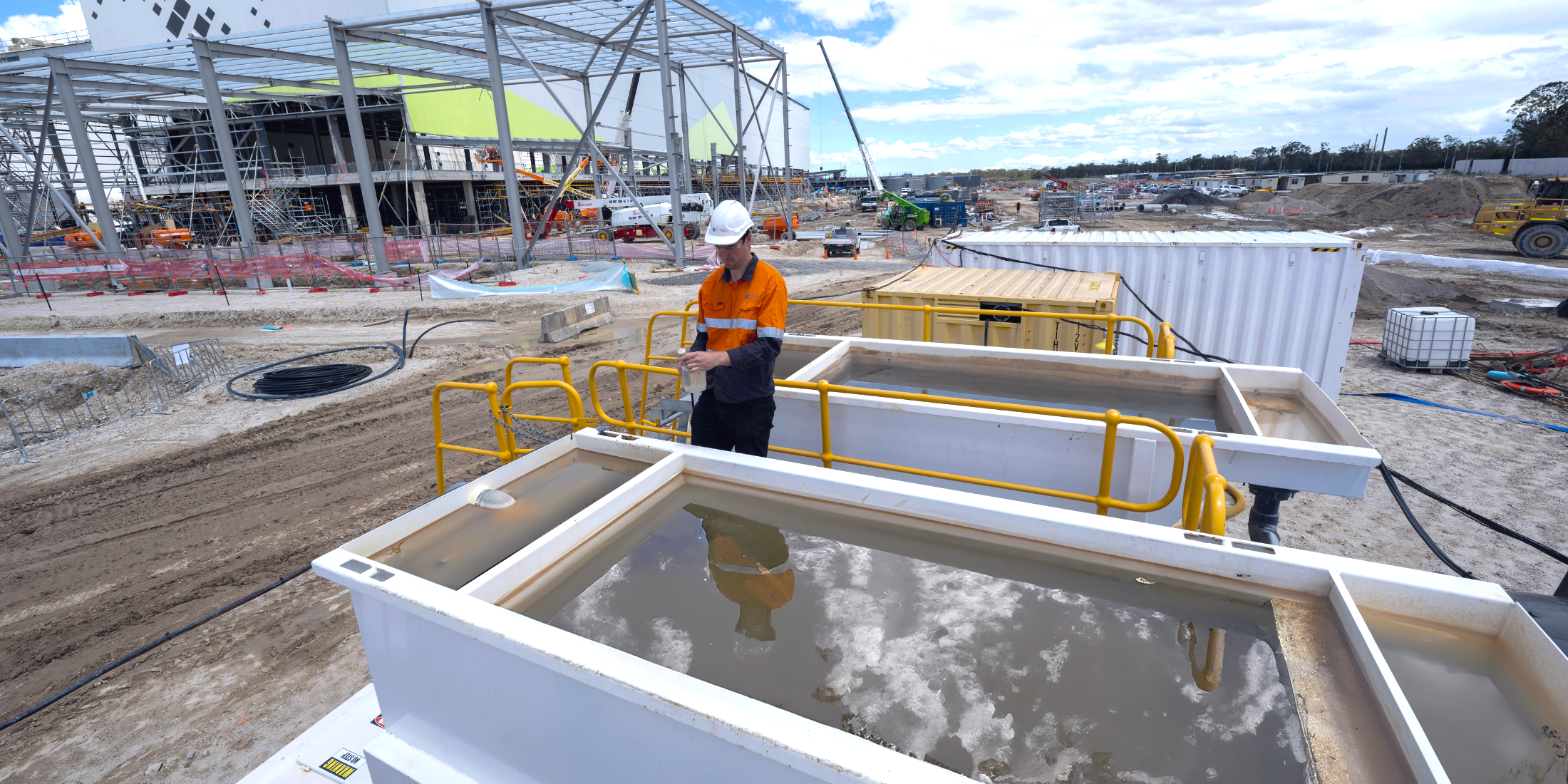
Due to the historical land use at Moorebank, trace per-and poly-fluoroalkyl substances (PFAS) contamination was present in the sub grade throughout the MoRDC Stage 2 Site. Stormwater run-off from rain events became contaminated with PFAS and required capture in various holding ponds to avoid contamination of the surrounding rivers/creeks.
To maintain holding capacity for future rain events, Richard Crookes Construction (RCC) engaged SciDev to design, construct and operate a water treatment plant (WTP) to treat and discharge the captured contaminated water to the environment.
During the construction of the distribution centre, Moorebank experienced long periods of heavy rain. As a result, on-site water storage was at risk of uncontrolled discharge. To mitigate against this, the WTP was mobilised and fully operational within four business days.
Summary
- All major components of the WTP were containerised and modular. The modular design allowed for rapid mobilisation and demobilisation within a small footprint, in an area with limited access.
- The treatment process consisted of four major steps: Clarification, Physical Filtration, Adsorption and Discharge (including validation sampling):
- Clarification: Coagulant was added to destabilise colloids, co-precipitate organics, and clarify the water. In addition to coagulation, the pH of the process water was constantly corrected to reduce settling times and concentrate bulk contaminants in the solid phase. The preconditioned water was dosed in-line with flocculant and processed through the two (2) clarifiers to remove solids from the process water.
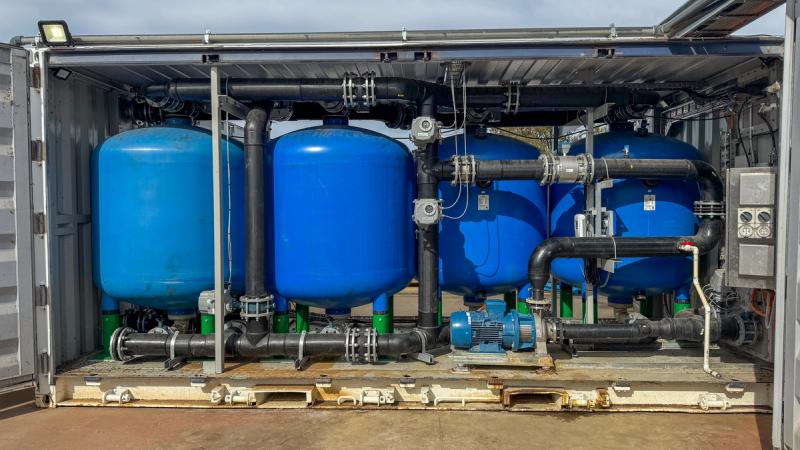
- Physical filtration: The first filtration stage consisted of physical filtration using zeolite in the filter vessels. This highly porous zeolite scrubbed the water of any solids remaining after the clarification stage.
- Absorption: After physical filtration, the process water was processed through filter vessels filled with activated carbon. This grade of carbon is produced from bituminous coal and was explicitly manufactured to enhance the adsorption of low-level PFAS, removing it from the water stream.
- Discharge (sampling): After the adsorption stage, the processed water was transferred into the discharge tank where pH and NTU monitoring occurred in accordance with the site-wide Environmental Protection Licence (EPL) and continuously discharged to the Point-of-Use (PoU).
Related solutions
Solutions used on this project
More projects
Related projects
Infrastructure
PFAS & Remediation, Dewatering +2 more
Camellia Remediation
Temporary water treatment plant to remove hexavalent chromium and other metals from surface water at Camellia, NSW.
Infrastructure
Reuse & Treatment
Erskineville Water Treatment Plant
Plant treating up to 530m³ of groundwater a day near Sydney Park's old legacy landfills, discharging clean water to the environment to the ANZECC 95th percentile level of ecological protection.
Infrastructure
PFAS & Remediation
Fiskville PFAS Water Treatment Plant
FluorofIX™ implemented for continuous discharge, removing PFAS and oxidisable precursors from contaminated ground and surface water at former CFA training site.
Talk to our team
Tell us about your site and we'll route your enquiry to the right engineer.